
Home > Organization > Fundamental Innovative Oncology Core(FIOC) > Office of Research Coordination > “Sugu-Yaru-Ka” Project (Rainbow Cloud)
“Sugu-Yaru-Ka” Project (Rainbow Cloud)
Update: 2026年11月05日
“Sugu-Yaru-Ka” Project (Comprehensive IRB Protocol: Rainbow Cloud)
The project currently covers cases from the National Cancer Center Hospital.
Purpose
Reverse translational research (rTR) is research that feeds back knowledge and information obtained from actual treatment and clinical studies into basic research. This project aims to identify genetic alterations that may serve as new therapeutic targets by performing panel testing (TOP2/NCC Oncopanel), whole-exome sequencing, RNA sequencing and other analyses on pre- and post-treatment tumor tissue and blood samples (including cell-free DNA), and thereby to advance drug discovery research and expand the indications of existing drugs.Eligible Cases
The project mainly covers patients with notable clinical outcomes encountered in routine practice, such as cases that rapidly developed drug resistance or super-responders. Analyses are performed upon request from any clinical department. After discussion among the Rainbow Cloud core members, including the attending physicians, analyses are performed according to the available clinical specimens, and genomic analysis results are returned in approximately 3–4 weeks.Examples of Project Outcomes
[Case 1] Efficacy of ABL1-specific inhibitor generations in a patient with acute lymphoblastic leukemia (ALL) harboring a novel PDGFRB fusion gene (joint research with the Department of Pediatric Oncology, National Cancer Center Hospital)
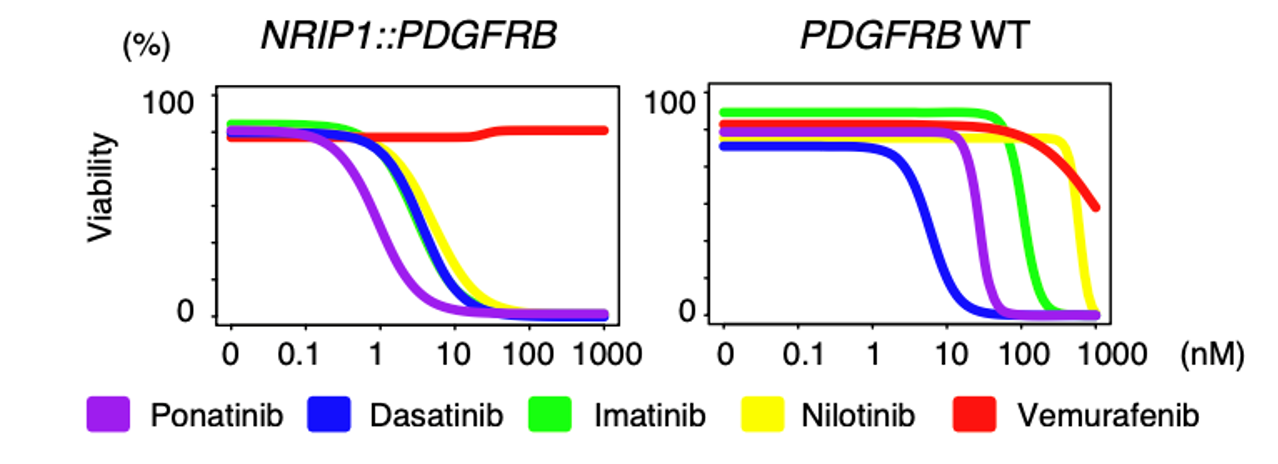
RNA sequencing of leukemia cells from a pediatric patient with blinatumomab-refractory ALL identified a novel oncogenic fusion gene, NRIP1::PDGFRB. Whole-exome sequencing revealed no other genetic alterations. The predicted fusion product did not contain the NRIP1 protein; it retained the C-terminal tyrosine kinase domain of PDGFRB but lacked the N-terminal extracellular and juxtamembrane domains. We considered that NRIP1 promoter-driven upregulation of truncated PDGFRB activates downstream signaling. In vitro assays confirmed enhanced autophosphorylation and cell proliferation-inducing ability of truncated PDGFRB, and the efficacy of ABL1-specific inhibitor generations, including imatinib, dasatinib, nilotinib and ponatinib, was validated. In this case, genomic analysis identified a targetable fusion gene, which led to treatment.Figure 1A. Schematic of the NRIP1::PDGFRB fusion gene (adapted from Fig. 1 of the original article)
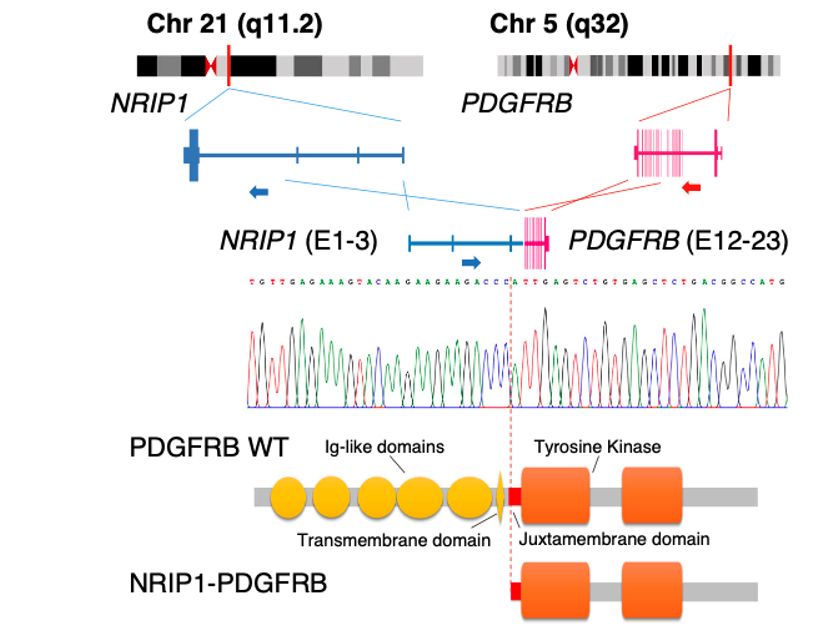
Figure 1B. Sensitivity of mouse Ba/F3 cells transduced with expression vectors to imatinib, dasatinib, nilotinib, ponatinib and vemurafenib (adapted from Fig. 2 of the original article). Not part of the Rainbow Cloud support
Miyazaki B, Ueno T, Sugiyama M, Kojima S, Arakawa A, Tao K, Tanimura K, Shiraishi K, Yagishita S, Kohsaka S, Kato M, Kiyokawa N, Goto Y, Yatabe Y, Hamada A, Mano H, Ogawa C, Tanaka Y. Promoter swapping of truncated PDGFRB drives Ph-like acute lymphoblastic leukemia. NPJ Precis Oncol. 2023 7(1):132. doi: 10.1038/s41698-023-00485-7. (PMID: 38071343)
[Case 2] Rapid response to lenvatinib and disease flare after discontinuation in a patient with thymic carcinoma (TC) harboring a KIT exon 11 mutation (joint research with the Department of Thoracic Oncology, National Cancer Center Hospital)
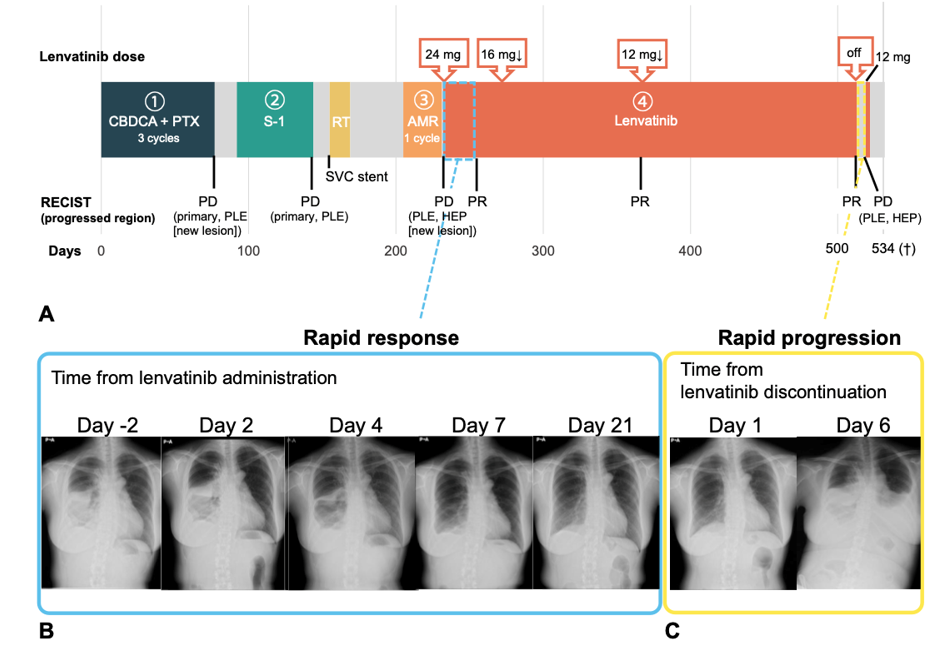
Lenvatinib produced a marked response in a patient with metastatic TC; however, after the drug was discontinued because of an adverse event, the patient experienced rapid disease progression known as a disease flare. To elucidate the cause, RNA sequencing was performed and identified a somatic in-frame deletion in KIT exon 11 (p.Q575_P577delinsH). The mutation was validated by whole-exome sequencing and was accompanied by copy-number amplification or loss of heterozygosity. This study suggested that KIT exon 11 mutations and gene amplification may serve as biomarkers predicting the efficacy of lenvatinib in patients with TC. In such cases, the potential risk of disease flare after discontinuation should also be considered.Figure 2. (A) Timeline of the patient’s clinical course; changes in chest X-ray images (B) after initiation and (C) after discontinuation of lenvatinib (adapted from Fig. 2 of the original article).
Torasawa M, Yoshida T, Shiraishi K, Goto N, Ueno T, Ichikawa H, Yagishita S, Kohsaka S, Goto Y, Yatabe Y, Hamada A, Mano H, Ohe Y. Rapid Response to Lenvatinib and Disease Flare After Discontinuation in a Patient With Thymic Carcinoma Harboring KIT Exon 11 Mutation: A Case Report. JTO Clin Res Rep. 2024 5(4):100657. doi: 10.1016/j.jtocrr.2024.100657. (PMID: 38706977)
Project Workflow
For details, please see the Rainbow Cloud page on the internal server:
http://int.res.ncc.go.jp/web/Rainbow_cloud/Rainbow_cloud.html