
Home > Organization > Divisions and Independent Research Units > Division of Cancer Therapeutics > Lab Members
Lab Members
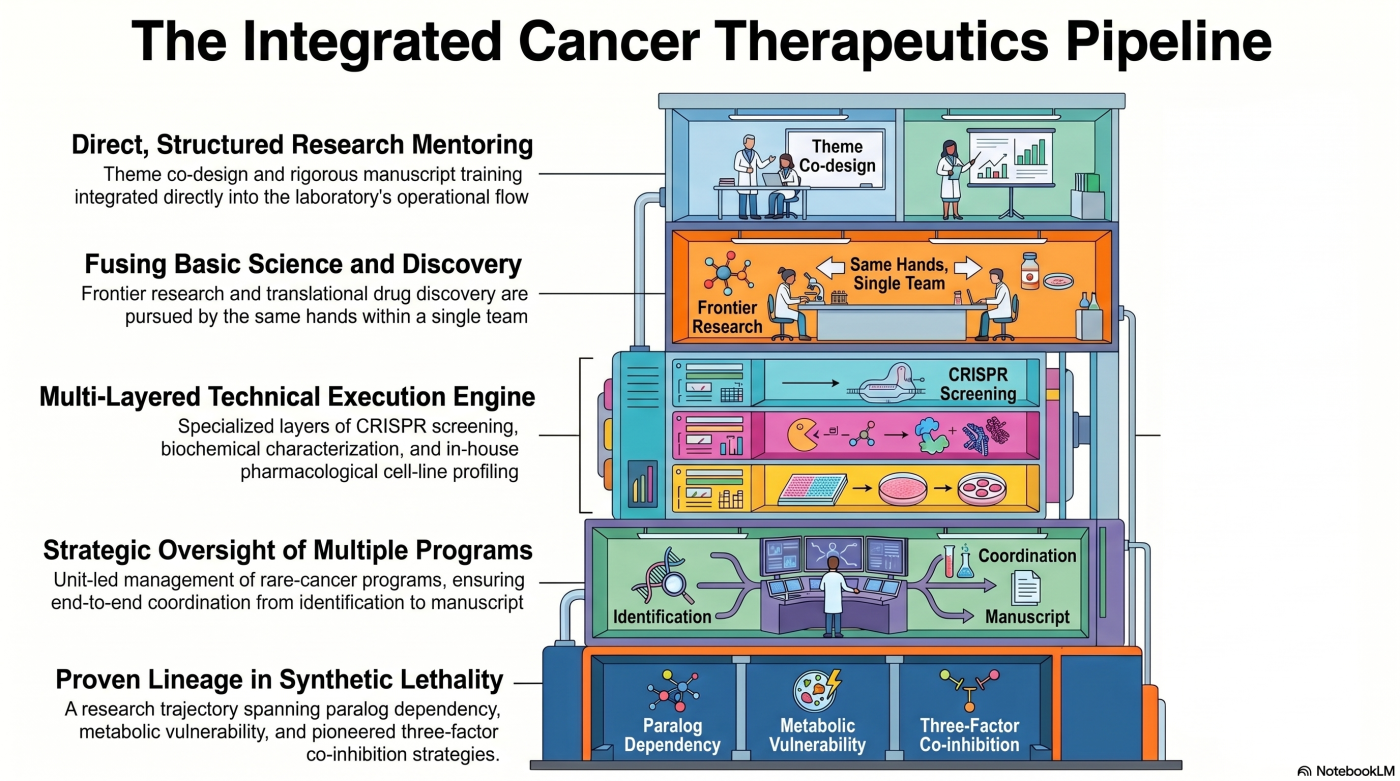
Our laboratory brings together researchers from medicine, pharmacy, basic science, and bioinformatics around a shared commitment: to identify cancer-specific vulnerabilities, define their molecular mechanisms, and advance them toward drug-discovery programs — all within a single, end-to-end pipeline. This page introduces our Principal Investigator, our team members, and our research environment.
Principal Investigator
Hideaki Ogiwara, Ph.D.
Position: Division Chief, Division of Cancer Therapeutics, National Cancer Center Research Institute
Specialty: Cancer therapeutics, synthetic lethality, chromatin biology, drug-target discovery
Contact: hogiwara [at] ncc.go.jp
Research Lineage and Current Focus
Dr. Ogiwara initiated his synthetic-lethality research program in the early 2010s, when the concept of synthetic lethality was still largely unfamiliar to the Japanese cancer-research community. Starting from chromatin-remodeling defects of the SWI/SNF complex, the laboratory's intellectual trajectory has unfolded across three landmark studies: paralog dependency between CBP and p300 in CBP-deficient cancers (Cancer Discov 2016) — the conceptual starting point of the laboratory's current research lineage; glutathione-metabolic vulnerability in ARID1A-deficient cancers (Cancer Cell 2019); and the paralog co-inhibition strategy as a three-factor synthetic-lethality framework, pioneered in our laboratory (Nat Commun 2024). A consistent stance runs through this trajectory: target identification is never an endpoint — the laboratory pursues the mechanistic and biochemical basis of each vulnerability. Current programs extend the paralog co-inhibition framework from SWI/SNF-deficient cancers to KRAS-mutant, SMAD4-deficient, and KDM6A-deficient backgrounds, and from rare and pediatric cancers to refractory adult solid tumors.
Laboratory Management Philosophy
Frontier basic science and translational drug-discovery are not separated in our laboratory — both are pursued by the same hands within the same team. Each member owns their research theme from the design stage; mentoring is direct and structured, with rigorous manuscript writing treated as core researcher training rather than as an afterthought. Laboratory discussions are open and data-centered across positions; PI, project researchers, and graduate students contribute on equal terms.
Selected Publications
- Sasaki M, Kato D, Murakami K, Yoshida H, Takase S, Otsubo T, Ogiwara H*. Targeting dependency on a paralog pair of CBP/p300 against de-repression of KREMEN2 in SMARCB1-deficient cancers. Nat Commun. 2024;15(1):4770. Representative study for the paralog co-inhibition strategy. → PubMed
- Ogiwara H*, Takahashi K, Sasaki M, Kuroda T, Yoshida H, Watanabe R, Maruyama A, Makinoshima H, Chiwaki F, Sasaki H, Kato T, Okamoto A, Kohno T*. Targeting the Vulnerability of Glutathione Metabolism in ARID1A-Deficient Cancers. Cancer Cell. 2019;35(2):177–190.e8. Foundational paper on metabolic vulnerability in ARID1A-deficient cancers. → PubMed
- Ogiwara H, Sasaki M, Mitachi T, Oike T, Higuchi S, Tominaga Y, Kohno T*. Targeting p300 addiction in CBP-deficient cancers causes synthetic lethality via apoptotic cell death due to abrogation of MYC expression. Cancer Discov. 2016;6(4):430–445. Established the CREBBP/EP300 paralog-dependency axis — origin of the laboratory's synthetic-lethality program. → PubMed
Recognition and Funding
Recognized by the Japanese Cancer Association (JCA Mauvernay Award, 2020; JCA Encouragement Award, 2017).
Holds adjunct appointments at Institute of Science Tokyo (Adjunct Lecturer, 2025–) and Nagasaki University (Cooperative Graduate School Professor, 2025–).
Major research funding from AMED (Japan Agency for Medical Research and Development) and JSPS KAKENHI as principal investigator.
External Profiles
→ For thematic context on the laboratory's research lines, see Research Highlights. For the laboratory's research foundations and collaboration opportunities, see Research Projects.
Our Team
The laboratory advances a multi-layered experimental program — spanning target identification, CRISPR/Cas9 screening, molecular cloning, cell-line model construction, pharmacological evaluation, protein analysis, and metabolic profiling. Each member maintains a primary technical focus while working across multiple experimental systems as projects require. Understanding each other's data and advancing from target discovery through mechanistic analysis to drug-discovery seed development as a single integrated flow is the working principle of the team.
Unit Head
TAKEUCHI Mariko, Ph.D.
Leading Multiple Research Programs in Parallel
- Focus: Chromatin regulation, metabolic vulnerability, SMARCB1-deficient rare-cancer and pediatric-cancer programs.
- Specialty: Molecular biology, metabolomics, cancer therapeutics.
- Role: Central to two core programs — the glutathione-metabolic vulnerability study in SMARCB1-deficient rare cancers (malignant rhabdoid tumor, epithelioid sarcoma) and the CBP/p300 paralog co-inhibition study in SMARCB1-deficient cancers. Maintains end-to-end oversight of target identification, pharmacological evaluation, mechanistic analysis, and manuscript construction simultaneously across multiple projects. Particular strength in reading the characteristics of rare-cancer cell models and determining the next experimental steps under limited available information.
- Key publications: Cancer Res 2026 (first author) / Nat Commun 2024 (first author)
Project Researchers
HIRANO Harumi — Translating Target Hypotheses into Experimental Systems
- Focus: CRISPR/Cas9 technology, molecular cloning, cell-line model construction.
- Role: Builds and maintains the laboratory's paralog-pair dual-knockout vector library; implements CRISPR screening and generates validation knockout lines for individual target candidates. Works across multiple experimental systems — bridging genome editing, pharmacological evaluation, and molecular biology from target identification through mechanistic analysis.
- Key publication: Mol Cancer Res 2026 (first author) — pyrimidine-metabolic vulnerability in ARID1A-deficient diffuse-type gastric cancer.
OKIMOTO Yoshie, Ph.D. — Supporting Mechanistic Validation Through Biochemical Characterization
- Focus: Protein expression analysis, western blotting, antibody validation.
- Role: Provides the biochemical layer of mechanism dissection — confirming changes in target-protein expression, signaling-pathway activation states, and protein-level responses to drug treatment. Her work connects genetic perturbations and pharmacological phenotypes to protein-level evidence, enabling the team to verify whether observed vulnerabilities are supported by defined signaling changes or target-protein responses.
TOMINAGA Akari — Enabling Pharmacological Reproducibility Through Cell-Line Panel Maintenance and In Vitro Evaluation
- Focus: Cancer cell-line culture, high-throughput compound screening, in vitro pharmacological assays.
- Role: Maintains the laboratory's in-house cancer cell-line panel and runs compound-sensitivity profiling across multiple genetic backgrounds in parallel. Reproducibility in synthetic-lethality research depends critically on verifying that a phenotype observed in one cell line is consistently reproduced across multiple genetic contexts and cancer types. Maintaining consistent cell states and assay conditions across the panel is essential for reproducible pharmacological evaluation.
Research Support Staff
MASUDA Hinako — The Operational Core — Ensuring Research Continuity
- Focus: Reagent and consumables management, accounting, shared-instrument operation, experimental support.
- Role: Maintains the conditions that allow every researcher to focus on research — reagent and consumables availability, accurate accounting, and shared-instrument readiness. Ensures that the day-to-day operational flow that underpins every experimental program never becomes a bottleneck.
Affiliated Graduate Students
- WAKU Takaaki — Nagasaki University Graduate School (Ph.D. course). Research theme: bioinformatics-driven discovery of novel synthetic-lethal targets, focusing on DepMap dependency reanalysis integrated with the laboratory's in-house cell-line panel.
- NOMURA Hiro — Institute of Science Tokyo Graduate School (Master's course). Research theme: novel synthetic-lethal targets in esophageal cancer, using database-driven drug-target screening approaches.
→ All thesis research is supervised directly by the PI within the laboratory.
Research Environment
Mentoring Approach
The laboratory's small size enables direct PI mentoring of every member.
- Theme co-design at entry — the first weeks after joining are spent aligning the member's research interests with the laboratory's directions; a primary thesis or project theme is co-designed rather than assigned.
- Regular progress dialogue — PI–member discussions on experimental direction, data interpretation, and next steps run on a regular cadence.
- Manuscript writing as core training — high-impact-journal logical writing is developed from the draft stage. Figure design, narrative architecture, and Discussion construction are all worked through with the PI.
→ For information on graduate-program pathways and research opportunities, please see the Contact and Access page.
Related Pages
- Home — laboratory overview and selected press releases
- Research Projects — research foundations, disease-focused programs, and collaboration opportunities
- Research Highlights — six thematic research areas
- Publications — selected publications by theme and chronological publication list
- Contact and Access — collaboration, academic, and media inquiries
Last Updated: 2026-05-19