
Home > Organization > Divisions and Independent Research Units > Division of Cancer Therapeutics > Publications
Publications
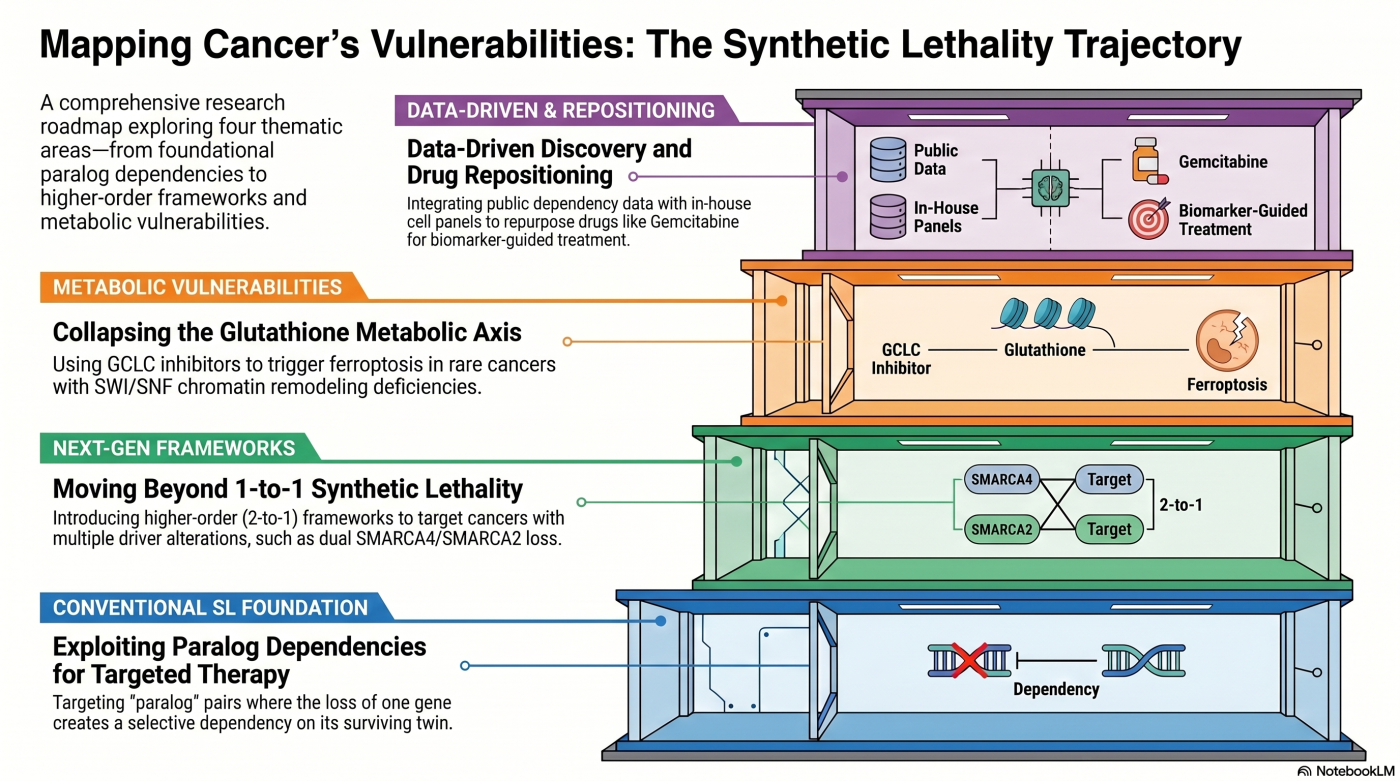
The papers below define the laboratory's intellectual trajectory across six research themes — from conventional synthetic-lethality frameworks and their higher-order extensions, through data-driven target discovery and metabolic vulnerability programs, to biomarker-guided drug repositioning. For thematic deep dives, see Research Highlights; for the disease-focused portfolio, see Research Projects.
Original Articles (Chronological)
Original Articles
2026
Takeuchi M, Okimoto Y, Fukushima M, Hirano H, Ogiwara H*.Targeting the CHD3 Chromatin Remodeler Exploits a Synthetic Lethal Vulnerability in Dual SMARCA4/SMARCA2-Deficient Cancers via Derepression of PARD3B.
NPJ Precis Oncol. 2026;10(1):315.→ PubMed
Takeuchi M, Ishikawa Y, Okada T, Kozaki R, Ogiwara H*.
A GCLC Inhibitor Enhances the Antitumor Efficacy of Glutathione Metabolic Pathway Inhibition in SMARCB1-Deficient Rhabdoid Tumors.
Cancer Res. 2026;86(12):2990-3004. → PubMed
Hirano H, Makinoshima H, Ogiwara H*.
ARID1A Deficiency in Diffuse-Type Gastric Cancer Promotes a Pyrimidine Metabolic Vulnerability.
Mol Cancer Res. 2026;24(6):518-532. → PubMed
2025
Saito R, Fukushima M, Sasaki M, Okamoto A, Ogiwara H*.Targeting USP8 Causes Synthetic Lethality through Degradation of FGFR2 in ARID1A-Deficient Ovarian Clear Cell Carcinoma.
NPJ Precis Oncol. 2025;9(1):69. → PubMed
Sasaki M, Kato D, Yoshida H, Shimizu T, Ogiwara H*.
Efficacy of CBP/p300 Dual Inhibitors against De-repression of KREMEN2 in cBAF-Deficient Cancers.
Cancer Res Commun. 2025;5(1):24–38. → PubMed
2024
Sasaki M, Kato D, Murakami K, Yoshida H, Takase S, Otsubo T, Ogiwara H*.Targeting dependency on a paralog pair of CBP/p300 against de-repression of KREMEN2 in SMARCB1-deficient cancers.
Nat Commun. 2024;15(1):4770. → PubMed
Sasaki M, Ogiwara H*.
Efficacy of glutathione inhibitor eprenetapopt against the vulnerability of glutathione metabolism in SMARCA4-, SMARCB1- and PBRM1-deficient cancer cells.
Sci Rep. 2024;14(1):31321. → PubMed
2023
Kanada R*, Kagoshima Y, Suzuki T, Nakamura A, Funami H, Watanabe J, Asano M, Takahashi M, Ubukata O, Suzuki K, Aikawa T, Sato K, Goto M, Setsu G, Ito K, Kihara K, Kuroha M, Kohno T, Ogiwara H, Isoyama T, Tominaga Y, Higuchi S, Naito H.Discovery of DS-9300: A Highly Potent, Selective, and Once-Daily Oral EP300/CBP Histone Acetyltransferase Inhibitor.
J Med Chem. 2023;66(1):695–715. → PubMed
2022
Kobayashi Y*, Takeda T, Kunitomi H, Chiwaki F, Komatsu M, Nagai S, Nogami Y, Tsuji K, Masuda K, Ogiwara H, Sasaki H, Banno K, Aoki D.Response Predictive Markers and Synergistic Agents for Drug Repositioning of Statins in Ovarian Cancer.
Pharmaceuticals. 2022;15(2):124. → PubMed
2020
Sasaki M, Chiwaki F, Kuroda T, Komatsu M, Matsusaki K, Kohno T, Sasaki H, Ogiwara H.Efficacy of glutathione inhibitors for the treatment of ARID1A-deficient diffuse-type gastric cancers.
Biochem Biophys Res Commun. 2020;522(2):342–347. → PubMed
2019
Ogiwara H*, Takahashi K, Sasaki M, Kuroda T, Yoshida H, Watanabe R, Maruyama A, Makinoshima H, Chiwaki F, Sasaki H, Kato T, Okamoto A, Kohno T*.Targeting the Vulnerability of Glutathione Metabolism in ARID1A-Deficient Cancers.
Cancer Cell. 2019;35(2):177–190.e8. → PubMed
Kuroda T, Ogiwara H, Sasaki M, Takahashi K, Yoshida H, Kiyokawa T, Sudo K, Tamura K, Kato T, Okamoto A, Kohno T.
Therapeutic preferability of gemcitabine for ARID1A-deficient ovarian clear cell carcinoma.
Gynecol Oncol. 2019;155(3):489–498. → PubMed
2016
Ogiwara H, Sasaki M, Mitachi T, Oike T, Higuchi S, Tominaga Y, Kohno T*.Targeting p300 addiction in CBP-deficient cancers causes synthetic lethality via apoptotic cell death due to abrogation of MYC expression.
Cancer Discov. 2016;6(4):430–445. → PubMed
2013
Oike T, Ogiwara H, Tominaga Y, Ito K, Ando O, Tsuta K, Mizukami T, Shimada Y, Isomura H, Komachi M, Furuta K, Watanabe S, Nakano T, Yokota J, Kohno T*.A synthetic lethality-based strategy to treat cancers harboring a genetic deficiency in the chromatin remodeling factor BRG1.
Cancer Res. 2013;73(17):5508–5518. → PubMed
Other Publications
For PI Hideaki Ogiwara's ALL publications, including DNA damage response, lung cancer genomics, and foundational SWI/SNF studies, please see:
→ PubMed Author Search: Hideaki Ogiwara
Review Articles
Selected peer-reviewed review articles in English:
Sasaki M, Ogiwara H*.Synthetic lethality-based therapeutics for cancers with epigenetic driver mutations in the SWI/SNF chromatin remodeling complex.
Cancer Sci. 2020;111(3):774–782. → PubMed
Selected Publications by Research Theme
1. Conventional Synthetic Lethality — 1-to-1 Paralog Dependency
The two-factor foundation: when one paralog of an essential pair is lost in cancer, the surviving paralog can become a selective dependency. We demonstrated this principle in SMARCA4-deficient lung cancer (SMARCA2 dependency) and CBP-deficient cancers (EP300/p300 dependency) — establishing the conceptual basis from which the paralog co-inhibition strategy later evolved.
Ogiwara H, Sasaki M, Mitachi T, Oike T, Higuchi S, Tominaga Y, Kohno T*. Targeting p300 addiction in CBP-deficient cancers causes synthetic lethality via apoptotic cell death due to abrogation of MYC expression. Cancer Discov. 2016;6(4):430–445. → PubMed | NCC press release (Japanese)
Representative study establishing the CREBBP/EP300 paralog-dependency axis. CBP loss creates dependency on the paralog p300 in small-cell lung cancer and B-cell lymphoma; p300 inhibition triggers MYC down-regulation and apoptosis. This established the conceptual foundation from which the three-factor paralog co-inhibition strategy evolved.
Oike T, Ogiwara H, Tominaga Y, Ito K, Ando O, Tsuta K, Mizukami T, Shimada Y, Isomura H, Komachi M, Furuta K, Watanabe S, Nakano T, Yokota J, Kohno T*. A synthetic lethality-based strategy to treat cancers harboring a genetic deficiency in the chromatin remodeling factor BRG1. Cancer Res. 2013;73(17):5508–5518. → PubMed
Established that SMARCA4 (BRG1)-deficient lung cancers depend on the paralog SMARCA2 (BRM) for SWI/SNF function. The starting point of the laboratory's paralog synthetic-lethality program.
→ Thematic deep dive: Research Highlights — Conventional Synthetic Lethality
2. Paralog Co-Inhibition — 1-to-2 Synthetic Lethality in SWI/SNF-Deficient Cancers
The three-factor extension: simultaneously inhibiting both members of a paralog pair overcomes the compensatory buffering that limits the two-factor approach. We established this strategy against SMARCB1-deficient rare cancers and subsequently extended it to broader cBAF-deficient backgrounds.
Sasaki M, Kato D, Murakami K, Yoshida H, Takase S, Otsubo T, Ogiwara H*. Targeting dependency on a paralog pair of CBP/p300 against de-repression of KREMEN2 in SMARCB1-deficient cancers. Nat Commun. 2024;15(1):4770. → PubMed | NCC press release (Japanese)
Representative study for the paralog co-inhibition strategy. Simultaneous CBP/p300 inhibition induces synthetic-lethal cell death in SMARCB1-deficient malignant rhabdoid tumor and epithelioid sarcoma. SMARCB1 loss de-represses KREMEN2 transcription, and dual CBP/p300 inhibition collapses this output, releasing pro-apoptotic KREMEN1 and preferentially inducing cell death in SMARCB1-deficient cells. The published research-use compound CP-C27 was used to validate the mechanism in vitro and in vivo.
Sasaki M, Kato D, Yoshida H, Shimizu T, Ogiwara H*. Efficacy of CBP/p300 Dual Inhibitors against De-repression of KREMEN2 in cBAF-Deficient Cancers. Cancer Res Commun. 2025;5(1):24–38. → PubMed
Extended the paralog co-inhibition framework from SMARCB1-deficient cancers to broader cBAF-deficient backgrounds, including SMARCA4-deficient non-small cell lung cancer and SS18-SSX-driven synovial sarcoma.
→ Thematic deep dive: Research Highlights — Paralog Co-Inhibition
3. Next-Generation Synthetic Lethality — Higher-Order Frameworks (2-to-1 and Beyond)
When multiple driver alterations coexist — such as dual SMARCA4/SMARCA2 loss — the conventional SMARCA2-targeting strategy no longer applies. We identified CHD3, the ATPase of the CHD3/NuRD chromatin-remodeling complex, as a synthetic-lethal target in this doubly-deficient context, introducing a 2-to-1 higher-order synthetic-lethality framework.
Takeuchi M, Okimoto Y, Fukushima M, Hirano H, Ogiwara H*. Targeting the CHD3 Chromatin Remodeler Exploits a Synthetic Lethal Vulnerability in Dual SMARCA4/SMARCA2-Deficient Cancers via Derepression of PARD3B. NPJ Precis Oncol. 2026;10(1):315.
CHD3/NuRD maintains a constitutive "epigenetic brake" at the PARD3B enhancer under SWI/SNF ATPase loss. CHD3 inhibition releases this brake, drives PARD3B de-repression, and attenuates MYC-pathway output in dual SMARCA4/SMARCA2-deficient cells — a gain-of-toxicity mode of synthetic lethality confirmed by in vivo CDX tumor regression. This work introduces cross-complex dependency and gain-of-toxicity synthetic lethality as new conceptual frameworks.
→ Thematic deep dive: Research Highlights — Next-Generation Synthetic Lethality
4. Data-Driven Target Discovery — DepMap Integration with In-House Cell-Line Panels
Context-specific re-analysis of public cancer dependency data, integrated with in-house cell-line panels absent from DepMap, surfaces rare-cancer-specific vulnerabilities that pan-cancer averaging obscures.
Saito R, Fukushima M, Sasaki M, Okamoto A, Ogiwara H*. Targeting USP8 Causes Synthetic Lethality through Degradation of FGFR2 in ARID1A-Deficient Ovarian Clear Cell Carcinoma. NPJ Precis Oncol. 2025;9(1):69. → PubMed
USP8, a deubiquitinating enzyme, was identified as a synthetic-lethal target in ARID1A-deficient ovarian clear cell carcinoma by context-specific DepMap re-analysis and orthogonal validation in our in-house OCCC cell-line panel. USP8 inhibition triggers FGFR2 degradation and attenuates STAT3 signaling, preferentially inducing cell death in ARID1A-deficient cells.
→ Thematic deep dive: Research Highlights — Data-Driven Target Discovery
5. Glutathione Metabolic Vulnerability in SWI/SNF-Deficient Cancers
Loss of SWI/SNF chromatin remodeling complex subunits creates collateral fragility in glutathione metabolism. Beginning with ARID1A-deficient cancers and extending to SMARCB1-, SMARCA4-, and PBRM1-deficient backgrounds, we have shown that glutathione synthesis becomes a selective dependency — and that GCLC inhibition triggers ferroptosis (iron-dependent cell death) in SMARCB1-deficient rare cancers.
Takeuchi M, Ishikawa Y, Okada T, Kozaki R, Ogiwara H*. A GCLC Inhibitor Enhances the Antitumor Efficacy of Glutathione Metabolic Pathway Inhibition in SMARCB1-Deficient Rhabdoid Tumors. Cancer Res. 2026. [Epub ahead of print] → PubMed | NCC press release (Japanese)
Novel GCLC inhibitors (GCLCi1 / GCLCi0) preferentially deplete intracellular glutathione in SMARCB1-deficient cells, inactivate GPX4, and induce ferroptosis. GCLCi showed higher SMARCB1-loss-vs-intact selectivity than tazemetostat in the in vitro models tested, with tumor-growth suppression in xenograft models. Collaborative work with Ono Pharmaceutical Co., Ltd.
Sasaki M, Ogiwara H*. Efficacy of glutathione inhibitor eprenetapopt against the vulnerability of glutathione metabolism in SMARCA4-, SMARCB1- and PBRM1-deficient cancer cells. Sci Rep. 2024;14(1):31321. → PubMed
Loss of SWI/SNF subunits (ARID1A, SMARCA4, SMARCB1, PBRM1) converges on down-regulation of the cystine transporter SLC7A11, the upstream bottleneck of glutathione synthesis — defining a shared epigenome-to-metabolism axis across SWI/SNF-deficient cancers.
Ogiwara H*, Takahashi K, Sasaki M, Kuroda T, Yoshida H, Watanabe R, Maruyama A, Makinoshima H, Chiwaki F, Sasaki H, Kato T, Okamoto A, Kohno T*. Targeting the Vulnerability of Glutathione Metabolism in ARID1A-Deficient Cancers. Cancer Cell. 2019;35(2):177–190.e8. → PubMed | NCC press release (Japanese)
Foundational study establishing the laboratory's metabolic-vulnerability program. ARID1A-deficient cancers depend on glutathione metabolism, demonstrating that epigenetic-driver loss can create a selective metabolic dependency.
→ Thematic deep dive: Research Highlights — Glutathione Metabolic Vulnerability
6. Drug Repositioning — Biomarker-Guided Repositioning of Gemcitabine
ARID1A-deficient cancers carry a pyrimidine-metabolic vulnerability distinct from glutathione dependency. ARID1A loss silences the nucleoside transporter SLC28A3, depleting intracellular dCTP and enabling a gemcitabine dual-hit mechanism. The combination of retrospective clinical data and a defined molecular mechanism provides a rationale for prospective evaluation of gemcitabine repositioning in ARID1A-deficient cancers.
Hirano H, Makinoshima H, Ogiwara H*. ARID1A Deficiency in Diffuse-Type Gastric Cancer Promotes a Pyrimidine Metabolic Vulnerability. Mol Cancer Res. 2026. [Epub ahead of print] → PubMed
ARID1A loss silences SLC28A3, depletes intracellular dCTP, and enables a gemcitabine dual-hit mechanism: dFdCTP induces DNA chain termination while dFdCDP inhibits RNR, impairing all three dCTP-supply routes in ARID1A-deficient cells. Validated by metabolomics, transcriptomics, ARID1A-rescue experiments, and a peritoneal-dissemination CDX model.
Kuroda T, Ogiwara H, Sasaki M, Takahashi K, Yoshida H, Kiyokawa T, Sudo K, Tamura K, Kato T, Okamoto A, Kohno T. Therapeutic preferability of gemcitabine for ARID1A-deficient ovarian clear cell carcinoma. Gynecol Oncol. 2019;155(3):489–498. → PubMed
Combining cell-line panel screening with retrospective clinical analysis, this study identified increased sensitivity to gemcitabine in ARID1A-deficient OCCC. In a retrospective cohort of 149 ovarian clear cell carcinoma patients, seven patients who received single-agent gemcitabine provided clinical proof-of-concept supporting ARID1A loss as a candidate response biomarker.
→ Thematic deep dive: Research Highlights — Drug Repositioning
Related Pages
- Research Highlights — six thematic research areas with mechanism-level explanation
- Research Projects — research foundations, disease-focused programs, and collaboration opportunities
- Home — laboratory overview and selected press releases
- Lab Members — laboratory team
- Contact and Access — collaboration, academic, and media inquiries
Last Updated: 2026-08-29